Introduction
Persistent knee pain can force people to stop running, skip stairs, and abandon favorite cardio routines, creating a rapid decline in fitness and function. Low-impact options let you maintain aerobic fitness while protecting inflamed or vulnerable knee tissue.
Knee pain keeps many active people sidelined: post-op patients, people with osteoarthritis, and those with chronic tendinopathy often report avoiding cardio because of fear of damage or flare-ups. Finding the best low-impact cardio for knee pain early makes it possible to keep circulation, aerobic capacity, and mood intact without increasing joint swelling or instability.
Why Choose Low-Impact Cardio When You Have Knee Pain
Low-impact cardio reduces the mechanical load through the knee joint while allowing safe aerobic training and functional practice. Choosing lower-load movements preserves joint tissue and enables consistent training that supports long-term outcomes.
Low-impact exercise aims to lower compressive and shear forces through the knee so that pain-provoking stresses are minimized while cardiovascular stimulus remains. Clinically, that means selecting activities that reduce peak ground reaction forces, shorten time at end-range knee flexion or extension, and avoid rapid decelerations and high-impact landings.
Low-impact exercise — movements that reduce or eliminate ground impact forces and rapid loading cycles on a joint while still producing sustained cardiovascular demand. Low-impact is not identical to non-weight-bearing; cycling and elliptical training are weight-bearing but low-impact, while deep-water running is essentially non-weight-bearing.
Reducing joint load works through two main mechanisms: buoyancy or external support (as in water or recumbent seating) and altering movement mechanics (as with an elliptical's gliding motion or shorter stride length when walking). Both strategies limit instantaneous load and cumulative microtrauma, which is particularly important during inflammatory flares or early post-operative stages.
Beyond immediate pain relief, low-impact cardio offers multiple benefits. It maintains aerobic capacity and metabolic health, supports weight management which reduces chronic joint load, improves muscular endurance of the quadriceps and hip stabilizers that protect the knee, and has mood-regulating effects through endorphin release. According to the American College of Sports Medicine, adults should aim for about 150 minutes per week of moderate aerobic activity, and low-impact modalities make that target more attainable for people with knee conditions.
Who should prioritize low-impact training? People with symptomatic knee osteoarthritis, recent meniscal or cartilage procedures, early post-operative protocols where impact is restricted, chronic patellar tendinopathy, or anyone in a pain flare should choose lower-load cardio first. In later rehab stages, gradually reintroducing higher-load or plyometric work may be appropriate under clinician guidance.
How to Choose the Best Low-Impact Cardio for Your Knee Pain
Selecting the right modality depends on diagnosis, current pain level, and practical constraints like access to equipment or pools. Match the exercise to your tissue tolerance, stage of recovery, and long-term goals for function and fitness.
Start by clarifying diagnosis and stage: acute injury or surgery often requires non-weight-bearing or very low-load activity for weeks, while chronic osteoarthritis usually benefits from gradual increases in low-impact loading. Red flags that alter choices include joint instability, acute swelling, mechanical locking, or signs of infection; in these cases consult a clinician before exercising.
Decide whether you need non-weight-bearing or just low-impact weight-bearing. Non-weight-bearing pool work and deep-water jogging remove gravity's compressive load and are ideal for acute post-op phases. Cycling (recumbent or upright) provides low ground reaction forces while allowing consistent leg motion; an elliptical reduces impact but preserves gait-like mechanics, which can help transfer gains back to walking.
Practical considerations matter. Pool access and convenient times may determine whether aquatic options are realistic. At home, a recumbent bike, compact rower, or under-desk mini-cycle offers routine options. Budget-conscious buyers can find durable recumbent bikes for home use in mid-range price brackets, while gyms commonly stock ellipticals and stationary bikes.
Intensity, duration, and progression should be individualized. Use rate of perceived exertion (RPE) as a guide — start at RPE 3–5/10 for moderate conditioning and progress toward RPE 6–7 for harder intervals. Session frequency of 3–5 times per week for 20–40 minutes is a safe target for many; clinicians often recommend shorter sessions multiple times per day during early rehab to avoid overload.
Consult a physical therapist or orthopedist when pain limits daily activities, when swelling or mechanical symptoms persist after activity, or when planning to return to higher-impact sports. A clinician can prescribe progressive loading, check fit on equipment, and provide objective markers of readiness to advance intensity.
The Best Low-Impact Cardio for Knee Pain
The following modalities reliably reduce knee joint loading while providing cardiovascular benefit; choose based on access, tolerance, and functional goals.
Swimming and Water Aerobics
Swimming and shallow water aerobics provide buoyant, low-load movement with clinically useful resistance for strength and endurance. The water's buoyancy and hydrostatic pressure lower joint compression and reduce swelling while enabling sustained aerobic work.
Lap swimming with non-aggressive strokes (freestyle, sidestroke, backstroke) keeps knee motion controlled. Avoid deep knee flexion and high-impact kicking motions; for people with anterior knee pain, sidestroke or gentle backstroke are often better tolerated. Water aerobics, including side-stepping, marching, and light resistance using aqua dumbbells, provides whole-body conditioning without high joint loads.
Modifications: use a buoyant belt in deep-water sessions if balance or flotation is a concern; reduce kick intensity and range if the knee is painful; perform exercises in warm water to reduce stiffness. A typical pool session is 20–40 minutes combining steady laps and 3–4 short intervals of higher effort (30–60 seconds), followed by easy movement.
Safety notes: check pool depth and entry/exit routes; ensure water temperature is appropriate (about 28–32°C / 82–90°F for therapeutic work); confirm incision healing and surgeon clearance after recent knee surgery before submerging incisions.
Warm-water pool sessions let people perform 20 to 40 minutes of continuous aerobic work with minimal knee compression, making aquatic training a realistic option during early rehabilitation.
Pool Running and Deep-Water Jogging
Deep-water jogging is a near-zero-impact substitute for running that preserves neuromuscular patterns and cardiovascular load. Using a flotation belt allows a vertical running position without heel strike, protecting cartilage and meniscal surfaces from repetitive impact.
Stand upright in deep water with a flotation belt; drive the knees and hips in a running pattern, focusing on vertical force rather than foot contact. Cadence guidance: aim for 140–160 steps per minute for running-specific training or 120–140 for brisk jogging. Sample interval: 30 seconds hard / 60 seconds easy x 8, progressing by increasing hard interval duration or reducing recovery.
Modifications: if hip pain appears, reduce stride height and emphasize shorter, quicker steps; if balance is poor, use shallower water and perform marching instead. Typical session length is 20–30 minutes including warm-up and cooldown.
Safety: ensure a competent lifeguard is present if you are unfamiliar with deep-water equipment; avoid cold water if you have vascular issues.
Recumbent Bike
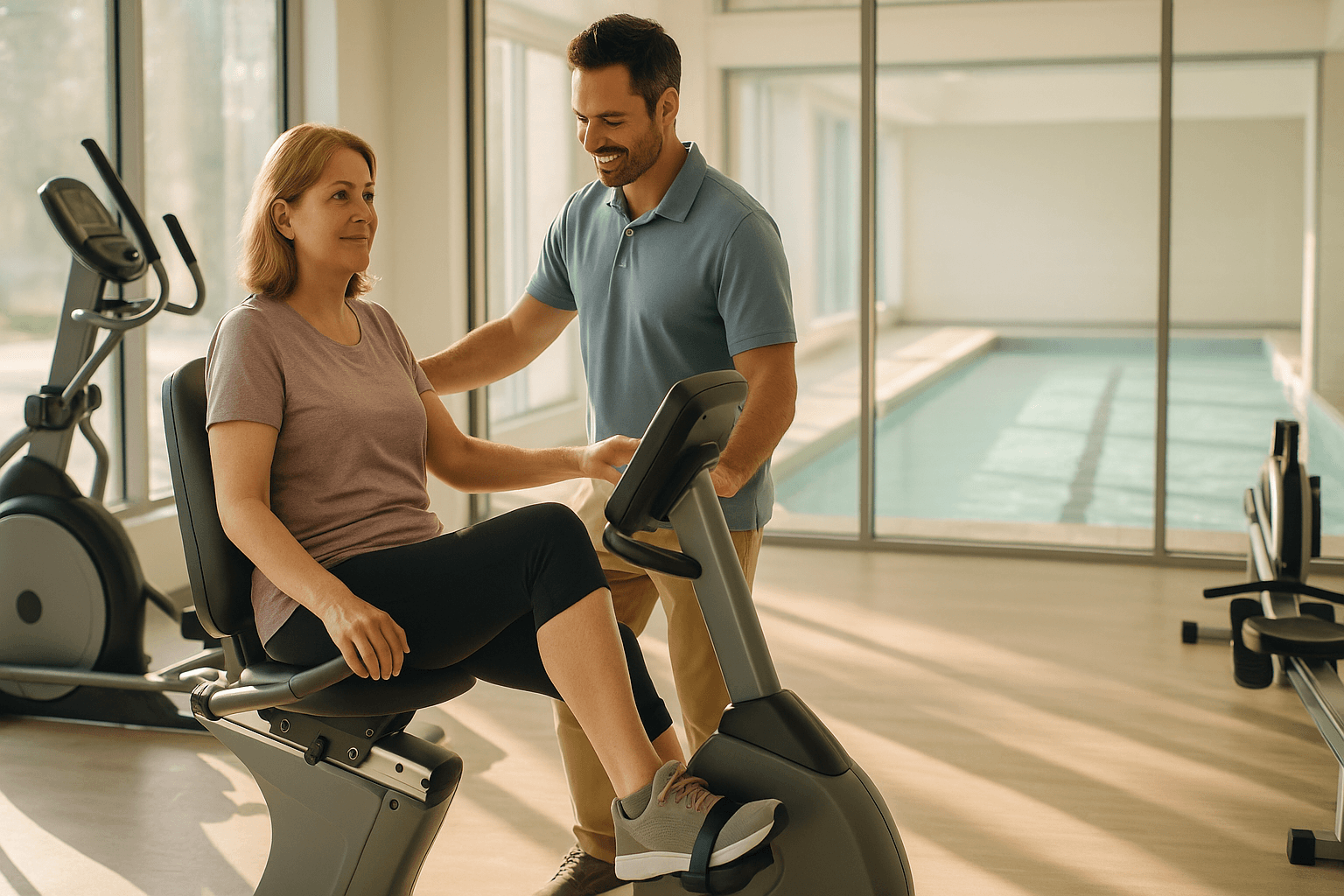
A recumbent bike reduces knee flexion extremes, supports the lumbar spine, and eliminates ground impact, making it one of the most knee-friendly machines. It allows progressive cardiovascular stress with minimal shock to knee structures.
Setup: adjust the seat so there is roughly a 25–35 degree bend in the knee at the pedal's furthest extension; ensure hips remain level and the back rests comfortably against the seat. Pedal stroke length should not force full knee extension; prioritize a smooth circular motion.
Workouts: steady 30 minutes at conversational pace, or interval set such as 10 x 1 minute slightly harder with 1 minute easy recovery. Precautions: avoid pushing with toes (which can increase patellofemoral stress) and limit very high resistance that forces excessive knee torque.
A properly fitted recumbent bike keeps knee flexion modest and reduces peak joint moments, enabling sustained cardio sessions with low mechanical stress.
Upright Stationary Bike (with caution)
An upright bike is acceptable when tolerated and properly fitted, but it often produces greater knee flexion and may increase patellofemoral load compared with a recumbent position. Choose it only when comfort and fit are verified.
Fit tips: raise the saddle so there is a small bend in the knee at full extension; avoid forward-leaning postures that increase quadriceps demand. When knee pain rises, switch to recumbent or lower resistance.
Elliptical Trainer
Ellipticals provide a walking-like gait with continuous gliding and low impact, which preserves functional transfer to walking while dramatically cutting peak joint forces. They are useful when gait patterning and walking endurance are goals.
Set resistance and incline to allow a smooth stride without overstriding; avoid very long strides that pull the knee into extreme ranges. Hands-on mode offloads some workload from legs and can help sustain longer sessions; hands-free mode increases lower-limb demand and stability requirements.
Rowing Machine
Rowing offers a low-impact, full-body cardio option if technique is correct and knee movement is limited to controlled extension during the drive. It increases cardiovascular work while sparing vertical impact.
Technique: initiate with a hip hinge, then drive through the legs keeping knees aligned and avoiding hyperextension; finish with a strong core and arm pull. Beginners should start with 10–15 minute sessions focusing on form, progressing to 20–30 minutes.
Precaution: poor technique can increase back strain or place unusual anterior knee loads; seek instruction if unsure.
Walking with Modifications
Modified walking on soft surfaces with shorter stride and controlled cadence remains one of the most accessible low-impact options for many people with knee pain. Small adjustments make walking knee-friendly without sacrificing function practice.
Choose packed dirt, rubber track, or grass instead of concrete; shorten stride length to reduce braking forces; use a slightly faster cadence with smaller steps. Poles (Nordic walking) can offload knee joint forces by transferring load to the upper body.
Progress by increasing duration, not speed, until you can walk 20–30 continuous minutes at moderate effort without swelling or pain increase.
Nordic Walking and Poles
Nordic walking uses poles to redistribute load and improve stability, reducing knee joint demand while engaging upper body muscles. Poles cut peak knee joint moments and improve balance on uneven terrain.
Technique: plant poles opposite to the forward leg, maintain an upright posture, and drive with the arms to contribute forward momentum. Use poles to descend slopes to limit eccentric knee loading.
Nordic poles can reduce knee joint loading by redistributing up to 20 to 30 percent of impact forces to the upper body during walking on level ground.
Seated Cardio and Chair-Based Workouts
Seated cardio is ideal for severe pain or limited mobility; it provides heart-rate elevation with almost no lower-limb joint load. Examples include seated marching, seated boxing with light hand weights, and mini-cycling under the desk.
Intensity increases by adding arm movement, hand weights, or faster cadence. Sessions of 10–20 minutes several times daily can accumulate into meaningful aerobic stimulus for people unable to stand for long periods.
Low-Impact Dance and Low-Impact Aerobics
Low-impact dance classes and aerobics preserve rhythm and coordination while eliminating jumps and harsh turns, offering social motivation and cardiovascular stimulus. Choose classes labeled low-impact or ask instructors for knee-friendly variations.
Adapt by stepping instead of hopping, keeping feet closer to the floor, and avoiding sudden pivots. Use chair modifications if balance is a concern.
Stairmaster / Step Machines with Caution
Step machines usually increase knee load, so use low-step settings, slow tempo, and minimal resistance if you choose them. They can train functional strength but are not first-line for significant knee pain.
Low-Impact HIIT Options
Short, carefully chosen intervals on low-impact equipment (bike, pool, elliptical) can provide metabolic benefits without joint trauma. Structure intervals with ample recovery and monitor pain response closely.
Sample low-impact HIIT: 8 rounds of 20 seconds hard / 40 seconds easy on an elliptical, aiming for RPE 7 on the hard efforts and full recovery between rounds.
Sample Workouts and Weekly Plans
Beginner 20-Minute Low-Impact Session for Knee Pain
Warm-up (5 minutes): seated marching or gentle pool walking, progressive limb mobilizations, ankle and hip circles.
Main set (12 minutes): Recumbent bike at steady pace for 12 minutes at RPE 4–5/10, or pool intervals of 2 minutes easy/1 minute slightly harder x 4.
Cool-down (3 minutes): slow pedal or gentle pool walking, then 5 minutes of stretching (quadriceps, hamstrings, calves).
RPE target: 4–5/10. Monitor for swelling or pain that increases beyond baseline.
30-Minute Fat-Loss Low-Impact Routine
Warm-up (5 minutes): dynamic mobility and light cycling.
Main set (20 minutes): circuit of elliptical 7 minutes moderate, rower 6 minutes steady, seated boxing 7 minutes; include intervals of 1 minute hard / 2 minutes easy within each block.
Cool-down (5 minutes): gentle mobility and static stretching.
Rehab-Focused Cardio for Recovery and Strength
Emphasize frequency and short duration: 10–20 minute sessions 4–6 times per week using pool walking, recumbent cycling, or seated cardio. Integrate 1–2 sets of lower-limb strengthening (closed-chain mini-squats, glute bridges) after low-impact aerobic work to combine blood flow with loading for tissue adaptation.
Progression Plan: 6-Week Example
Week 1–2: 3–4 sessions/week, 15–20 minutes, RPE 3–4. Focus on technique and pain monitoring.
Week 3–4: 3–5 sessions/week, 20–30 minutes, introduce short intervals (30–60 seconds) at RPE 6.
Week 5–6: 4–5 sessions/week, 30–40 minutes, increase interval duration or reduce recovery; begin functional walking sessions on soft surfaces if pain-free.
Progressing from 15-minute low-load sessions to 30–40 minute workouts over six weeks is a safe, evidence-informed approach for many people recovering from knee pain.
Safety, Form, and When to Stop
Good technique, thoughtful warm-up, and simple pain rules protect knee tissue while allowing beneficial exercise; stop if swelling or progressive pain appears.
Key technique cues by modality:
- Pool: maintain upright posture, avoid excessive kicking range, use a flotation belt for deep-water running.
- Bike: set saddle height to achieve slight knee bend at full extension, pedal smoothly, avoid toe-dominant push.
- Elliptical: use a short, natural stride and moderate resistance; keep hips level.
- Rower: lead with the hips, knees track over toes, avoid hyperextension on finish.
- Walking: shorten stride, increase cadence, choose softer surfaces.
Warm-up and cool-down checklist: 5–10 minutes of light aerobic movement, joint-specific dynamic mobility (hip circles, ankle pumps), brief activation of quads and glutes (isometric holds or mini-bridges), and a 5-minute cool-down with static stretching. These steps reduce stiffness and prime tissues for load.
Pain rule and red flags: use a pain-monitoring rule such as staying below a 3–4/10 increase from baseline during activity and avoiding any progressive swelling. If pain or swelling increases and persists for 24 hours, reduce intensity and consult a clinician. Seek immediate medical attention for new instability, locking, progressive night pain, fever, or wound-related concerns after surgery.
When to seek medical attention or physical therapy: persistent effusion, mechanical symptoms (catching or locking), increasing functional limitation despite conservative care, or post-operative protocols requiring supervised progression. A physical therapist can tailor loading progressions and confirm readiness for higher-impact return to sport.
Complementary Exercises: Strength, Mobility, and Balance
Combining low-impact cardio with targeted strength and mobility work reduces cumulative knee load, improves joint control, and supports long-term pain reduction. Strength increases the tissues' capacity to handle daily loads and decreases reliance on passive structures.
Why strength matters: Quadriceps and glute strength improve shock absorption and knee alignment. Improving hip abductor and external rotator strength reduces dynamic knee valgus, a common contributor to knee pain. Evidence-based guidelines consistently pair aerobic exercise with strengthening for osteoarthritis management.
Key exercises to pair with cardio (perform 2–3 times weekly):
- Glute bridges: 2–3 sets of 10–15 reps
- Mini-squats (closed-chain to 45 degrees): 2–3 sets of 10–12 reps
- Side-lying or standing hip abduction: 2–3 sets of 12–15 reps
- Calf raises: 2–3 sets of 12–15 reps
- Single-leg balance holds progressing to dynamic reach: 3 x 20–40 seconds
Mobility and foam rolling: gentle quadriceps and IT band foam rolling, hamstring mobility, and ankle dorsiflexion work prepare the kinetic chain for safer loading. A 5–10 minute mobility circuit post-cardio is effective.
Weekly template combining cardio and strength: 3 low-impact aerobic sessions (20–40 minutes) plus 2 strength sessions focusing on lower-limb and hip construction. Keep one day for active recovery such as easy pool walking.
Equipment Recommendations and Buying Guide
Choose equipment that matches your goals, space, and budget; prioritize adjustability and ergonomic setup to protect knees.
Best recumbent bike picks:
- Budget option: basic recumbent bikes from established home-fitness brands that offer seat adjustability and at least eight resistance levels; good for starting programs at home.
- Mid-range: models with better frame stability, larger flywheels, and built-in programs that allow interval structuring—useful for progressive training.
- Premium: commercial-grade recumbents with robust warranty, wide seat, and advanced monitoring features for athletes and heavy users.
Best ellipticals for low impact: choose units with a short stride length if you are of shorter stature, adjustable incline, and smooth magnetic resistance to avoid jerkiness.
Pool gear: flotation belts for deep-water running, aqua dumbbells for added resistance, and water shoes for traction. These items expand exercise options safely.
Shoes, orthotics, and insoles: a cushioned shoe with medial support and a stable heel reduces painful pronation and can lower knee stress; custom orthotics may help people with structural malalignment—consult a clinician for fitting.
Apps and trackers: select apps that record RPE, session duration, and perceived pain to monitor trends; simple heart-rate monitoring helps guide intensity progression.
Choosing adjustable equipment that fits your body and allows gradual resistance increases is more important for knee protection than buying the most expensive model.
Evidence Summary and Clinical Notes
Low-impact aerobic exercise is supported by clinical guidelines and systematic reviews as effective for pain reduction and functional improvement in knee osteoarthritis and many knee conditions.
According to the American College of Sports Medicine, regular aerobic and resistance exercise improves pain and function in adults with knee osteoarthritis. A Cochrane review (2015, updated periodically) found that exercise programs including aerobic and strengthening elements reduce pain and improve physical function in knee osteoarthritis compared to no exercise. Randomized trials consistently show aquatic and land-based exercise are both beneficial; choice depends on access and tolerance.
Practical clinical takeaways:
- Begin with the lowest-load modality that provides an aerobic stimulus and does not cause progressive swelling.
- Pair aerobic sessions with strength training to maximize functional gains and joint protection.
- Use simple pain-monitoring rules and adjust load if pain or swelling increases beyond acceptable limits.
Limitations and trade-offs: aquatic training minimizes joint load but may not transfer fully to land-based function; conversely, elliptical and cycling offer better transfer but slightly higher knee torque. Rehabilitation should include gradual task-specific training when return to running or high-impact activity is a goal.
Conclusion
A structured, low-impact approach preserves cardiovascular fitness and supports knee recovery while limiting harmful joint stresses; choose one accessible modality and progress slowly. Picking an option that fits daily life—pool, recumbent bike, or elliptical—matters more than the theoretical superiority of any single machine.
An idea not covered explicitly above is the role of variability: alternating two low-impact modalities within the week reduces repetitive stress on a single tissue pathway and can improve adherence by preventing boredom. For example, couple three recumbent bike sessions with two pool sessions to distribute load and practice different motor patterns.
Action checklist: select one modality you can access consistently, perform the 20-minute beginner routine once this week, track pain and swelling for 24 hours afterwards, and adjust based on response. If symptoms flare beyond acceptable pain levels or mechanical issues appear, seek targeted assessment from a physical therapist or orthopedist.
FAQ
What is the single best low-impact cardio for knee pain? Swimming or deep-water running are the least joint-loading options, while recumbent bikes and ellipticals are excellent accessible choices depending on your tolerance and access; choose based on which you can perform consistently without increased swelling.
Can walking make knee pain worse? Walking can be safe and beneficial when adjusted for softer surfaces, shorter stride, and controlled cadence; stop and seek evaluation if pain increases substantially, swelling appears, or mechanical symptoms develop.
Is cycling bad for knees? Properly fitted cycling, especially on a recumbent bike, is low impact and often recommended; avoid excessive resistance and poor seat position, and consult a clinician if pain persists despite correct setup.
Can low-impact cardio help with osteoarthritis? Yes, according to the American College of Sports Medicine and systematic reviews, regular low-impact aerobic exercise reduces pain, improves function, and supports weight management in knee osteoarthritis when combined with strengthening.
How long before I see improvement in knee pain? Many people notice improved symptoms and endurance within 4 to 8 weeks with consistent low-impact exercise, but timelines vary by diagnosis and adherence; track progress and adjust based on functional milestones.
Is swimming safe after knee surgery? Swimming is often safe once incisions are fully healed and your surgeon or physical therapist has cleared water immersion; start with gentle pool walking and avoid aggressive kicking until strength and range are appropriate.
What intensity should I use when exercising with knee pain? Aim for moderate intensity guided by RPE 4–6/10 or a conversational pace; reduce intensity if pain rises beyond your pain-monitoring threshold or if swelling increases.
Can low-impact HIIT work for knee pain? Short, carefully chosen intervals using non-impact modalities can be effective for fitness and metabolic outcomes; ensure adequate recovery, controlled technique, and no worsening pain after sessions.